


Practical tips from Swiss Stylies
Correctly positioning the fan
Learn how to optimally place your fan, avoid drafts, and significantly improve your indoor climate.
How to Use Fans Correctly
Proper Fan Placement: 10 Tips for a Better Indoor Climate in Summer
Simply placing a fan anywhere and turning it on only utilizes a fraction of its performance. The right placement makes all the difference: between drafts and pleasant coolness, between inefficient operation and a noticeably better indoor climate.
Whether it's a desk, pedestal, or floor fan — the basic principles are the same: intelligently directing air currents, balancing heat layers, and choosing the right time to ventilate. The following tips show how this works in practice — and how Swiss Stylies models go a step further with well-thought-out features like a timer function, oscillation, and 3D air circulation.
FAQ. Tips & Tricks
Why shouldn't a fan be pointed directly at people?
It's better to keep some distance – that's the short answer.
A fan provides cooling, but should not be aimed directly at you or other people permanently. Especially at head height, a constant airflow can quickly become unpleasant.
Better:
Keep a distance of 2 to 3 meters from your seat or bed. This way you can enjoy a
pleasant breeze without constantly sitting in a draft. It becomes even more comfortable
with the oscillation function, as the airflow is distributed throughout the room and
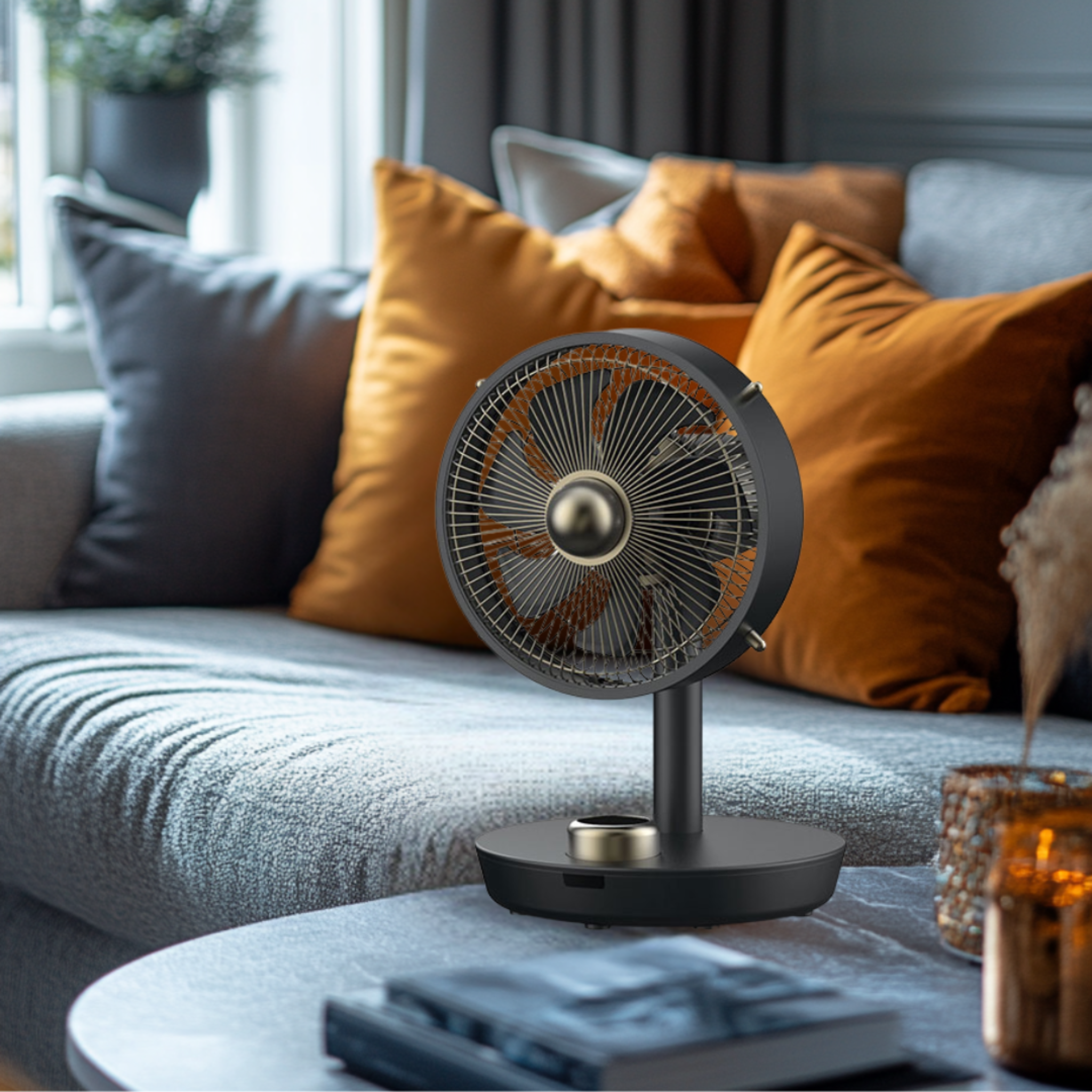
no one is constantly being blown at. Swiss Stylies models like the Cepheus
offer adjustable oscillation angles of 30°, 60° and 90°.
Ideal for precisely this application.
More tips with questions and answers
Placed at floor level and tilted slightly upwards, a fan circulates the
room air particularly effectively. Warm air that collects under the ceiling
is mixed with the cooler air in the lower area.
The result is a more balanced indoor climate and a noticeably more pleasant
freshness throughout the room.
Floor models with a tilting head, such as the Swiss Stylies Castor, are particularly effective.
On very hot days, a fan would otherwise draw the warm outside air directly into the room – the opposite of what you want. Therefore, it makes more sense to keep windows closed during the day and use the fan for air circulation within the room.
Only in the early morning or late evening, when the outside air is cooler, is it worthwhile to use the fan near a window. Then, the fan helps to distribute fresh air quickly and targeted throughout the room.
Early in the morning or late in the evening—that's when the outside air is significantly cooler than the indoor air. Place the fan near an open window so that
the fresh air is drawn in and distributed more quickly.
Models with 3D air circulation, such as the Swiss Stylies
Tari, are particularly practical.
It moves air horizontally and vertically, ensuring an even distribution of fresh air throughout the entire room.
A fan works particularly effectively when it moves the coolest available air.
This area is often on the shady side of the house or in an adjoining hallway.
From there, the fan can direct the more pleasant air into the warmer room, providing noticeable freshness with little effort.
In the evening, use two opposite openings, for example, a window and a door, or two windows.
Position the fan to blow the warm air outside. This will automatically draw cooler air in from the other side, allowing a heated room to cool down much faster.
For a fan to perform at its best, it needs enough space.
If furniture, curtains, or walls are too close to the device, the airflow is hindered, which can not only weaken performance but also lead to more noise
or vibrations.
An unobstructed placement ensures better
air circulation and quieter operation.
Cables and stands should be positioned so that no one can trip over them.
Especially in the office or in frequently used living spaces, it is advisable to run cables
along the wall or in cable ducts. This keeps the area safe
and tidy.
No, fans do not make you sick. A cold is caused by viruses, not by air movement. However, constant drafts can become uncomfortable: they can dry out mucous membranes and cool down certain parts of the body.
Therefore, Swiss Stylies recommends never directing the airflow constantly and directly at the head, throat, or neck, but instead opting for indirect, pleasant air circulation, for example, via the oscillation function.
For many, a fan in the evening is a welcome relief.
Nevertheless, it should not run continuously at night, and especially not directly pointed at you.
A timer function is more practical, as it allows the device to run only while falling asleep and then automatically switches it off.
Fans don't just move air, but unfortunately also dust, pollen, and other fine particles. This can exacerbate allergic symptoms such as irritated eyes, sneezing, or coughing.
Therefore, it is especially important for allergy sufferers to regularly clean the fan and keep the room as dust-free as possible.
During allergy season, it also helps to ventilate preferably during times with low pollen counts.
During the warmer months, it's best to do it every few days. Otherwise, dust on the blades or
protective grilles will be recirculated in the room every time the device is switched on.
A damp cloth is enough to improve air quality and maintain the performance
of the device.
Yes, this is possible if the airflow is directed straight onto the face or skin for a longer period of time. People with sensitive eyes or contact lenses often notice this particularly quickly. Indirect air circulation is more pleasant.
Drinking enough and ensuring balanced humidity if necessary can also help.
Expertise & Author
This article was created in collaboration with Stylies, the Swiss manufacturer of high-quality air treatment devices, and Daniel Gwerder.
Daniel Gwerder of Salesbroker GmbH has been an expert in health and indoor climate for over 20 years and shares his knowledge in a well-founded, understandable, and practical way.
You can find more about Daniel on LinkedIn