



Which humidifier is right for you?
Why where you live, your water hardness and your daily habits are key to choosing the right humidifier.
Two homes. The same humidifier. Two completely different experiences.
Does that make the humidifier a bad one? Not necessarily. Perhaps the technology simply wasn't the right match for the local tap water. Whether you live in the Jura, the Swiss Plateau, the Alps or on Lake Zurich can make a difference when choosing your humidifier.
We show you how the four main humidifier systems work, where their strengths and limits lie, and which one suits your home best.
Before we talk about devices: do you need a humidifier at all?
During the heating season in particular, the relative humidity indoors can drop considerably. Cold outdoor air often contains little water vapour. When it is warmed up inside your home, its relative humidity falls.
The effects can feel unpleasant: dry mucous membranes, irritated eyes or static electricity. Wooden furniture, parquet floors and musical instruments also react to changes in humidity.
However, a feeling of dryness does not always mean that your indoor air is actually too dry.
The Swiss Federal Office of Public Health recommends this range during the heating season. On very cold days, humidity should ideally not exceed 40 % because of possible condensation on cold building surfaces.
Our first tip: Measure the humidity with a hygrometer over several days before buying a device. Too much humidity can be just as problematic as too little. Tips for optimal humidity
The four humidifier systems: how they really work
Jump straight to the system you're interested in, or read through them in order. At the end of this chapter you'll find all four compared side by side.
Evaporative humidifiers: natural, economical and easy
Water evaporates without any visible mist.
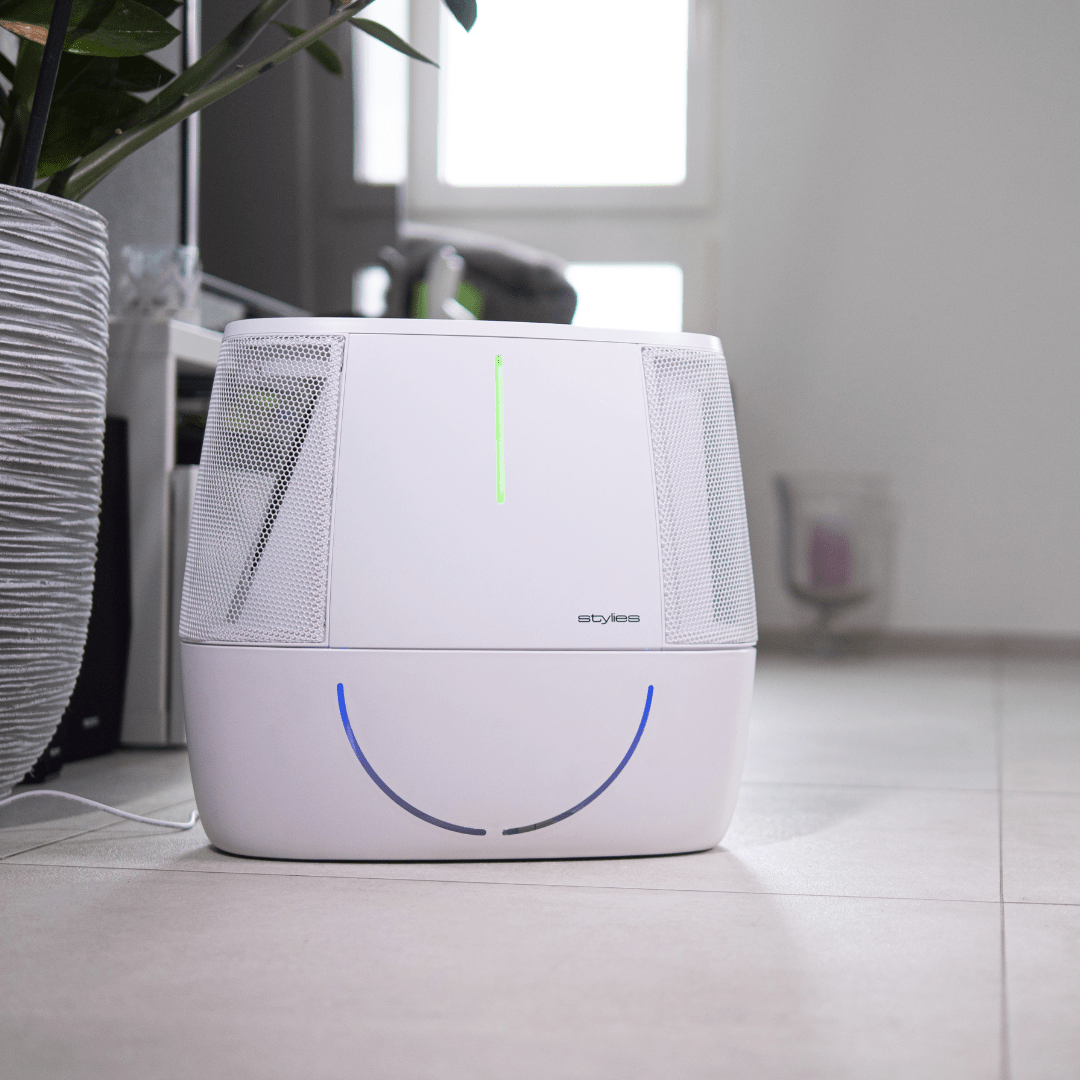
An evaporative humidifier works on a simple natural principle: a filter element absorbs water, and a fan draws dry room air across it. Part of the water evaporates, and the humidified air flows back into the room.
The key point: dissolved minerals largely stay behind in the device and the filter instead of spreading through the room as white dust. In addition, the evaporation rate naturally decreases as the relative humidity rises.
Why choose an evaporative humidifier
- Low power consumption, no water heating
- No visible mist
- Hardly any mineral deposits on furniture
- Well suited to regions with hard tap water
- Pleasant, continuous humidification
Good to know
The humidification output depends on factors such as room temperature, humidity and airflow.
Filter elements need to be cleaned or replaced regularly.
If used incorrectly, an evaporative humidifier can also contribute to excess humidity.
Families, households with hard tap water, people with delicate furniture surfaces and anyone looking for an energy-saving solution for regular use.
Stylies tip: The evaporative humidifiers ALAZE and ALAZE APP use DAST technology (Direct Air Stream Technology) for efficient, natural humidification.
Discover evaporative humidifiers →Ultrasonic humidifiers: fast, quiet and efficient, but water-dependent
High-frequency vibrations create ultra-fine water droplets.
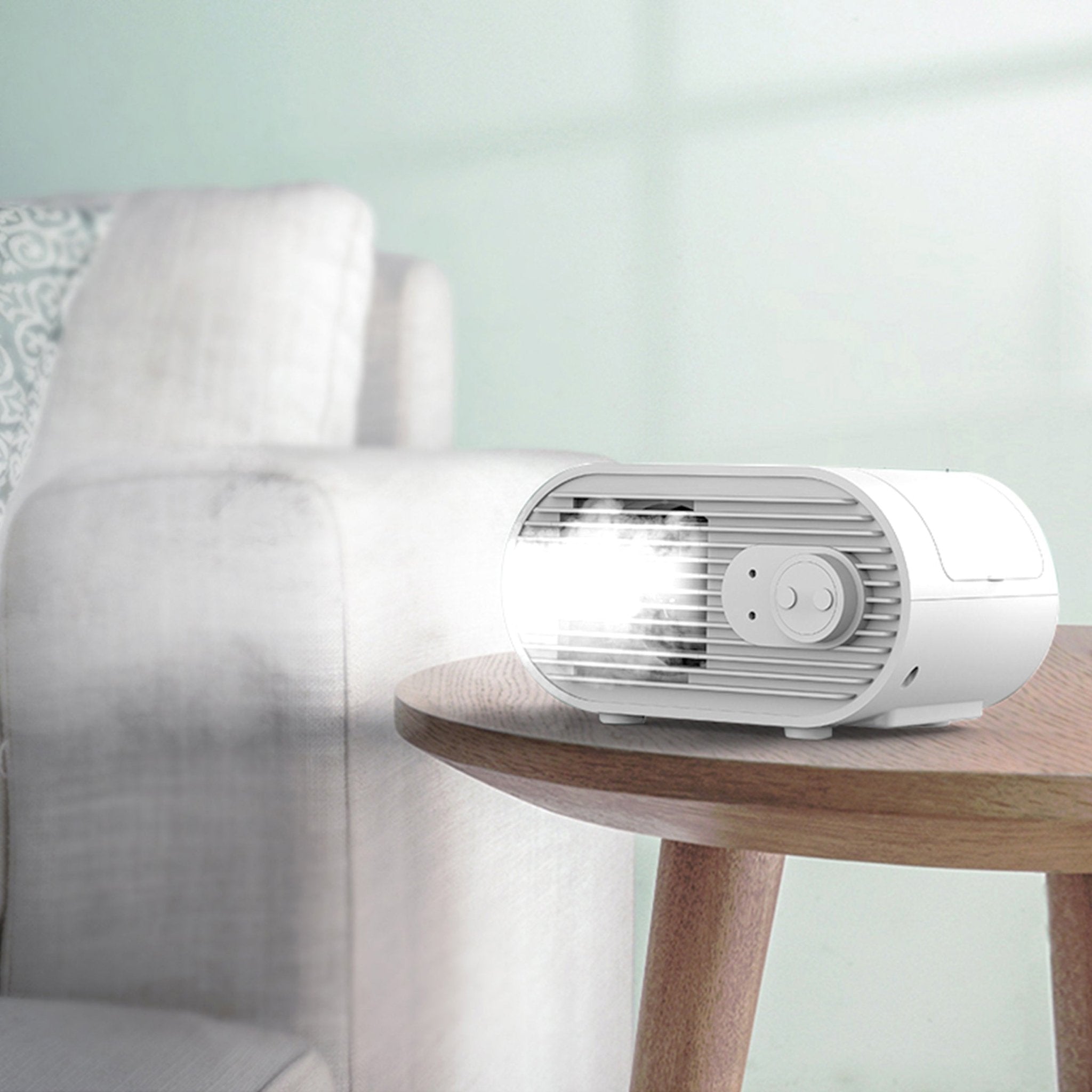
Ultrasonic humidifiers use a vibrating membrane that turns water into a fine, cool mist. The mist spreads through the room, where the tiny droplets evaporate.
The big advantage: the process needs comparatively little energy and can run very quietly. The visible mist shows immediately that the device is working. But this is exactly where a special feature lies that many buyers underestimate.
When the droplets evaporate in the air, mineral residues can remain. With hard tap water, these can become visible as a fine white dust on furniture, glass surfaces and electronic devices. The higher the mineral content and the more water is atomised, the more noticeable this effect can become.
Why choose an ultrasonic humidifier
- Fast, easily adjustable mist output
- Comparatively low energy consumption
- Very quiet operation possible
- Compact devices for different room sizes
- Cool mist with no hot steam outlet
Good to know
With mineral-rich water, there is a risk of white deposits.
With poor hygiene, microorganisms from the tank can be carried into the air with the droplets. Fresh water and careful cleaning are therefore particularly important.
Households with low-mineral water or suitable water treatment, people who value very quiet operation and anyone looking for a compact solution with high humidification output.
Stylies tip: Models such as LYNX, LEONIS and TITAN show how versatile ultrasonic technology can be.
Discover ultrasonic models →Steam humidifiers: powerful, with heated water
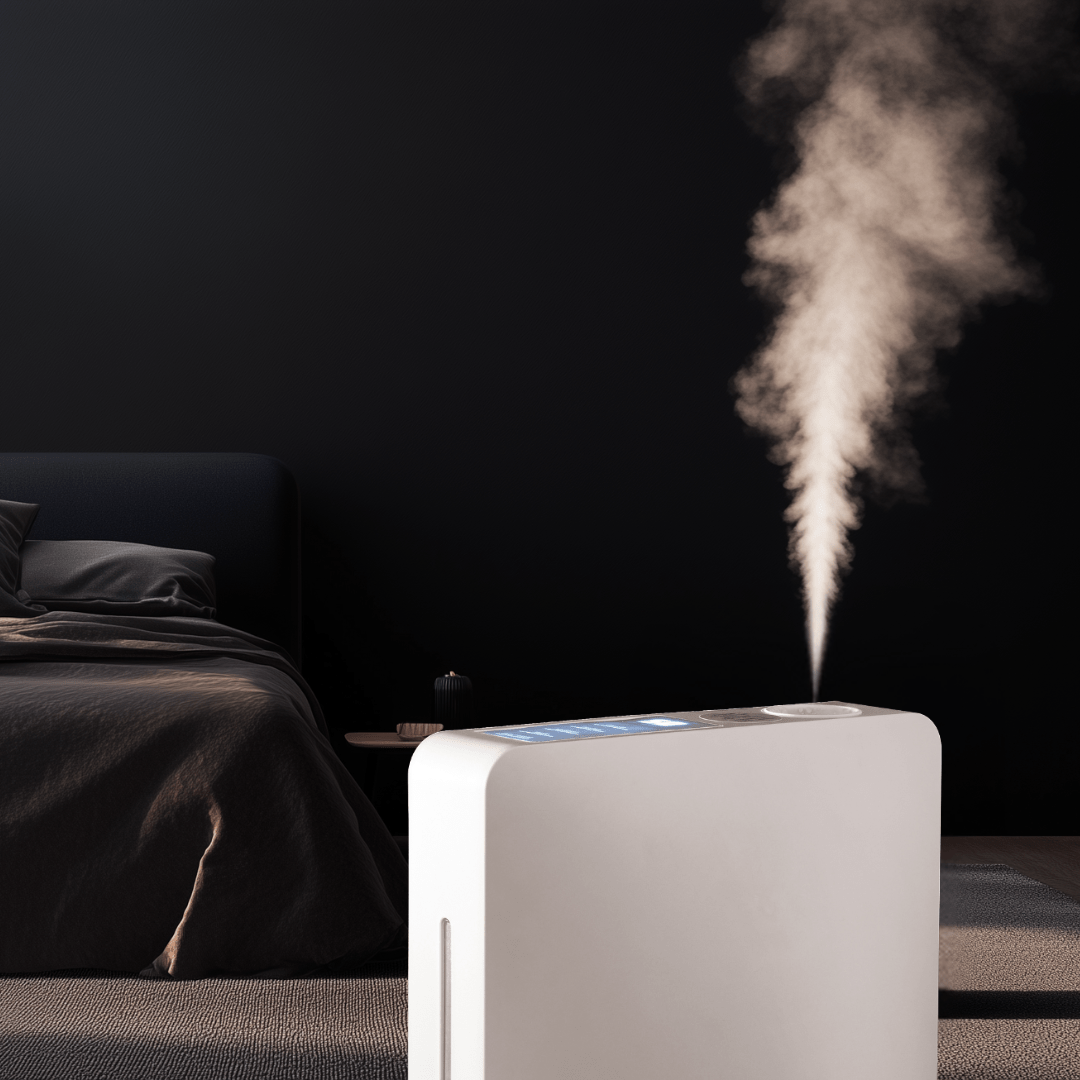
Water is heated and released as steam.
A steam humidifier works much like a kettle. The water is heated to close to boiling point, and the resulting steam is released into the room.
The high temperature significantly reduces the germ load of the steam released. Dissolved minerals mostly remain in the device as residue, so mineral dust on furniture does not normally occur.
Why choose a steam humidifier
- High humidification output possible
- Heating the water reduces germs in the steam released
- No typical white dust issue
- Can also be used with hard water
- A good choice when fast humidification is needed
Good to know
Heating water uses considerably more electricity than cold evaporation or ultrasonic atomisation. Hard water causes limescale deposits that need to be removed regularly.
Caution, heat: Hot steam and hot water can cause scalds. In households with small children or curious pets, the device must be positioned with care.
People who prefer high humidification output and the principle of heating water, who accept higher energy costs and can position the device safely.
Stylies tip: The steam humidifiers SIRIUS and ASTRA rely on powerful water heating and feature humidity control.
Discover steam humidifiers →Air washers: humidify while capturing particles
Natural evaporation meets additional particle separation.
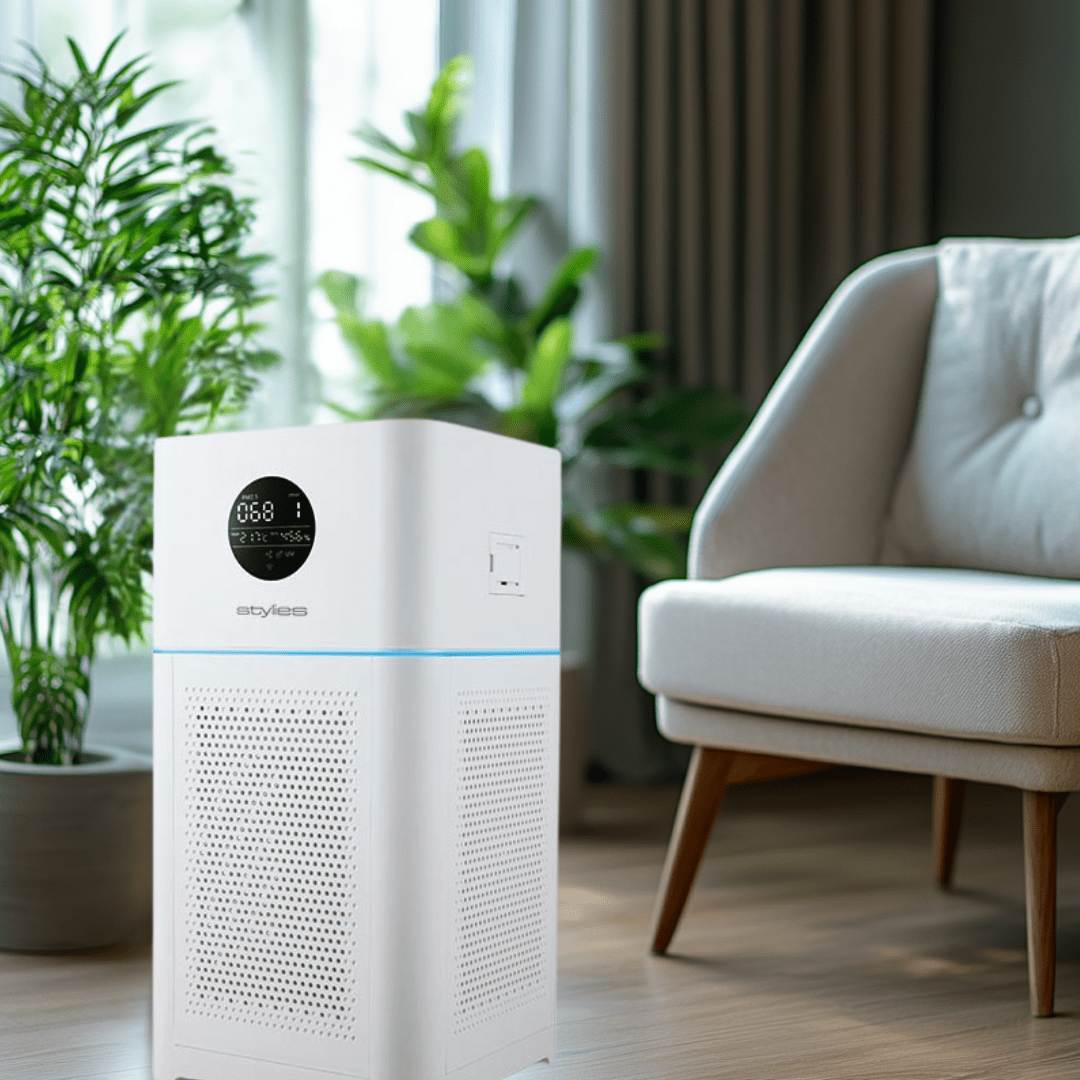
An air washer combines two functions: it humidifies the indoor air and can at the same time capture part of the dust and pollen particles carried in it.
In the Stylies air washers ANTARES and ANTARES PRO, this is done by a moist filter element combined with DAST technology. The room air flows through the system, releases part of its particles onto the filter surface and absorbs evaporated water at the same time.
As with classic evaporative humidifiers, there is no visible mist. Minerals are not carried into the room in the same way as with ultrasonic technology.
Why choose an air washer
- Humidification and additional particle separation in one device
- Natural cold evaporation
- Low energy requirement possible
- Well suited to hard water
- Ideal for larger, regularly used living spaces
Good to know
Not every air washer is equivalent to a specialised HEPA air purifier. For the targeted removal of very fine particles, proven filter performance and the Clean Air Delivery Rate (CADR) are what count.
An air washer does not replace regular ventilation, nor the cleaning and replacement of its filters.
People who want to address particle levels in their home as well as humidity. Particularly interesting for households with large living areas and a regular need for humidification.
Stylies tip: ANTARES PRO combines natural humidification with app control, making it easy to manage your indoor climate.
Discover ANTARES →The four systems at a glance
| System | Energy demand | White dust with hard water | Visible mist | Main care focus |
|---|---|---|---|---|
| Evaporative | low | hardly any | no | Clean / replace filter |
| Ultrasonic | comparatively low | possible | yes, cool | Fresh water, tank hygiene, limescale filter if needed |
| Steam | significantly higher | not a typical issue | steam, hot | Descale regularly |
| Air washer | low possible | hardly any | no | Clean / exchange filter |
Advantage What to keep in mind
The often underestimated factor: where in Switzerland do you live?
This is where choosing the right humidifier gets really interesting. Switzerland is geologically diverse, and the rock layers our drinking water flows through influence its composition.
Lots of lime in the water can make the difference
Large parts of the Jura mountains consist of limestone. As water flows through these layers, it dissolves calcium and magnesium compounds, which can lead to increased water hardness. Real examples show how much the values vary even within one region:
28.9–35 °fH
24–27 °fH
18–30 °fH
So water hardness can vary even within a single town or region.
What does this mean when buying? If you live in the Jura and atomise mineral-rich tap water directly with an ultrasonic device, white deposits can form on your furniture. In this situation, an evaporative humidifier or air washer is often the easier choice. A steam humidifier also avoids the typical white dust issue, but uses more energy and needs descaling more often with hard water.
And what about the Swiss Plateau and the Alps?
Altitude also affects climatic conditions in winter and therefore the need for humidification. On its own, however, it says little about the hardness of your tap water.
How to find out how hard your water is
In Switzerland, water hardness is usually given in French degrees of hardness (°fH).
The higher the mineral content, the more carefully you should consider using an ultrasonic humidifier. With moderately hard or hard water, evaporative humidifiers and air washers are especially worth considering. You can find your exact water hardness from your local water utility or on the Swiss drinking water portal.
Which humidifier suits your lifestyle?
Not every household has the same humidification needs. Here are our recommendations for typical living situations. Do you recognise yourself?
The young family with children
You want pleasant humidity, but no hot steam outlets?
The household in the Jura with hard water
You're already battling limescale on your kettle or taps?
The light sleeper
You want as little operating noise as possible and no distracting lights in the bedroom?
The energy-conscious household
Your humidifier will run often and for long periods during the heating season?
Living spaces with wood, parquet or delicate surfaces
You want to control humidity and avoid mineral deposits on furniture?
With an additional interest in air purification
Besides humidification, you also want to address dust and larger particles?
The right technology is only half the decision
A good humidifier needs to suit not only your tap water, but also your room. So keep the following points in mind as well.
Room size & volume
A small bedroom has different requirements from an open-plan living and dining area. Ceiling height, heating habits and air exchange also influence the humidification output required.
Hygrostat & automatic control
Automatic humidity control helps maintain the desired range. A separate hygrometer is still useful, as cold exterior walls or windows can have different conditions from where the device stands.
Noise level
Low operating noise is especially important in the bedroom. Compare the actual operating settings, not just the maximum output.
Cleaning & maintenance
Every humidifier system needs care. Standing water, deposits and dirty filters should not be left unattended for long.
Running costs
Consider not only the purchase price, but also power consumption as well as filters, limescale cartridges and other consumables. An inexpensive device is not automatically the most economical solution.
And what about limescale filters and water treatment?
Limescale filters can make it easier to use ultrasonic devices with harder water. Stylies, for example, offers limescale filter cartridges for compatible ultrasonic models that reduce the minerals in the water.
Important: Such cartridges have a limited capacity. Their effectiveness depends on water quality and timely replacement. They do not guarantee complete mineral removal under all conditions.
Water from a central softening system is not automatically mineral-free either. Classic ion exchangers swap calcium and magnesium ions for other ions.
If you want to avoid white deposits as reliably as possible, low-mineral or demineralised water expressly suitable for ultrasonic devices is the better choice. Always follow the manufacturer's instructions.
If you have permanently hard tap water and don't want the extra effort of water treatment, an evaporative humidifier or air washer is often the simpler option.
Frequently asked questions about choosing the right humidifier
Which humidifier is best for hard water?
An evaporative humidifier or air washer is often the most practical choice, because dissolved minerals largely stay in the device during evaporation. Steam humidifiers are also an option, but need regular descaling and use more energy.
Are ultrasonic humidifiers unsuitable for hard water?
Not in principle. With suitable water treatment, they can be used there too. Without it, however, there is an increased risk of mineral deposits on surfaces.
Which humidifier uses the least electricity?
Evaporative and ultrasonic devices are typically among the most energy-efficient systems. Actual consumption depends on the model and the setting. Because they heat water, steam humidifiers usually need considerably more energy.
Which humidifier is suitable for the bedroom?
A quiet device with automatic humidity control and, ideally, lights that can be switched off. This can be either an evaporative or an ultrasonic model. Your water quality and personal noise preferences also play a role.
Do I need to clean my humidifier every day?
With portable devices, the water should ideally be changed daily and the tank emptied and dried as needed. The US Environmental Protection Agency (EPA) recommends thoroughly cleaning portable humidifiers about every three days. Also follow your device's care instructions and the replacement intervals for filters and accessories.
More care tips: hygienic humidification starts in the water tank →
Our recommendation: understand first, then decide
There is no single humidifier that is the best solution for everyone and every home. A high-quality ultrasonic humidifier can work excellently with soft or suitably treated water. The same device can cause unnecessary cleaning effort in a household with hard tap water.
Not sure? Ask ANNA.
You don't have to work through technical data sheets on your own. Our digital assistant ANNA helps you narrow down the right humidifier technology for your home and find suitable Stylies models.
Simply tell her:
Expertise & author
This article was created in collaboration with Stylies of Switzerland.
Daniel Gwerder has been working on health, indoor climate, retail and customer value for more than 20 years and shares expert knowledge in a clear, practical way. STYLIES® – For an indoor climate that truly suits you. Expert knowledge from Swiss-Stylies. Technology explained clearly, so you don't just buy any humidifier, but the right one.
Read more